News
Better forecasting of weather processes in winter
14 Jan 2026
The international NAWDIC measurement campaign researches the dynamics of weather systems over the North Atlantic.

14 Jan 2026
The international NAWDIC measurement campaign researches the dynamics of weather systems over the North Atlantic.
Severe wind gusts, heavy precipitation, and cold air outbreaks are extreme weather events that tend to occur during the cold winter months in Europe. The international NAWDIC measurement campaign over the North Atlantic, which is coordinated by Karlsruhe Institute of Technology (KIT), is launching in January 2026 to better understand these events. With data from extensive aircraft and ground measurements, the researchers are collaborating with national and international partners to analyze the underlying processes and improve weather forecasting models, with the goal of allowing more precise forecasting of severe weather events.
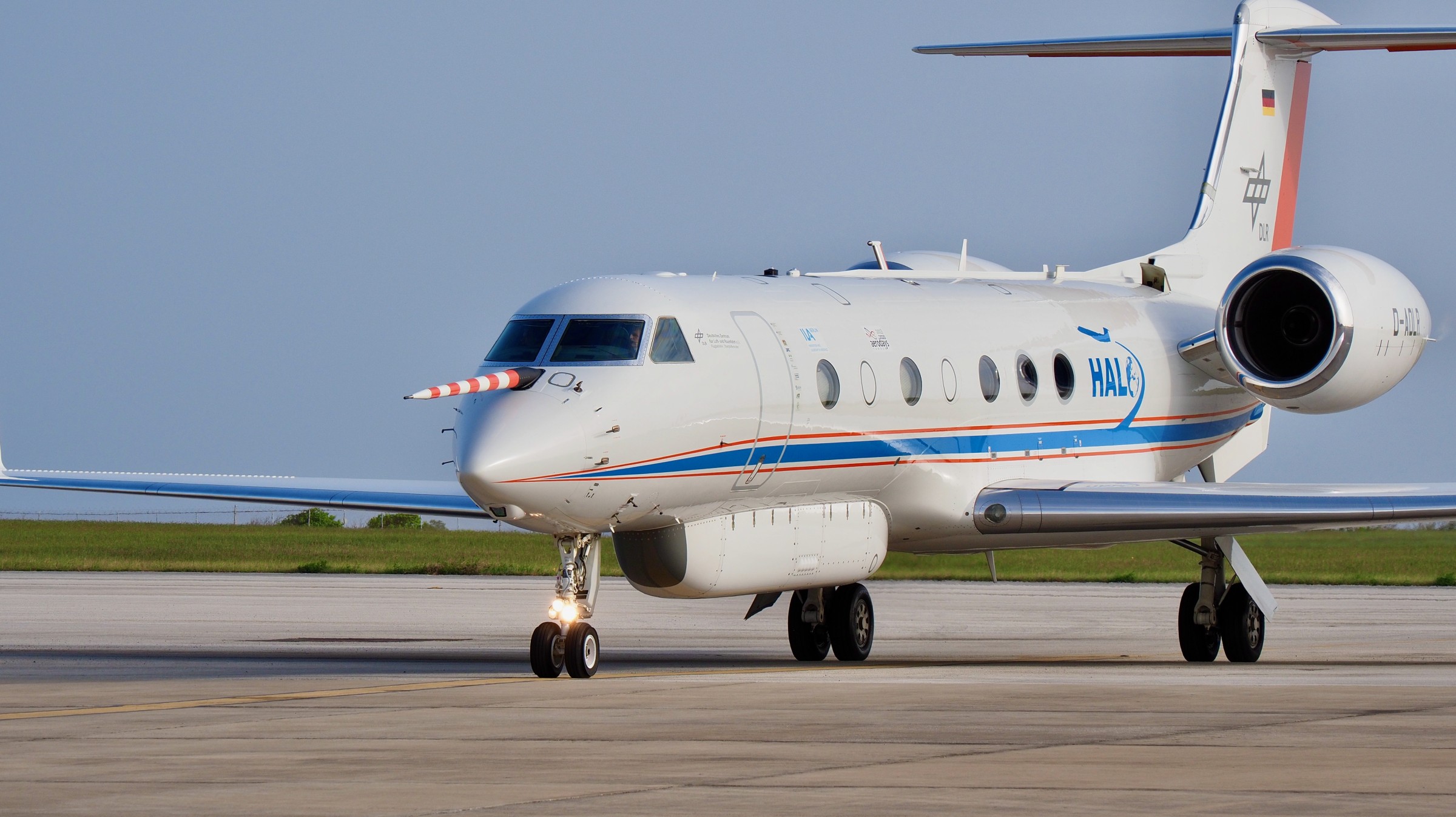
The German research aircraft HALO forms the core of the NAWDIC measurement campaign. State-of-the-art remote sensing instruments document water vapor transport and the interaction between the atmosphere and the ocean.
© Bernhard MayerFrom the North Atlantic to Western Europe, winter storms develop that can reach hurricane-like wind speeds, cause millions in damage, and in extreme cases endanger human life. Precisely predicting the location, timing, and intensity of such extreme weather events has proved challenging. Many of the physical processes that lead to these events in Europe take place over the Atlantic, which is not adequately covered by regular observation systems.
The large-scale NAWDIC (North Atlantic Waveguide, Dry Intrusion, and Downstream Impact Campaign) measurement campaign will help improve weather forecasts and climate models through detailed aircraft and ground-based observations of the atmosphere, carrying out measurements in precisely those regions for which existing models are suspected to have systematic flaws.
The researchers are particularly interested in how dry, cold air that comes down from high altitudes – known as dry intrusions – affects atmospheric circulation, cloud structures, and winds. When these dry air masses break through to the ground, they can trigger strong winds, turbulence, and storms. As the source of moisture for much precipitation in Europe, the North Atlantic plays a key role here. To date, moisture absorption processes over the Atlantic, especially those that occur during dry intrusion events, have not been exactly represented in weather forecasting models. NAWDIC intends to change this.
The core of the campaign is the German research aircraft HALO. State-of-the-art remote sensing instruments, such as the water vapor lidar WALES and the wind lidar HEDWIG, measure humidity and wind below the aircraft up to an altitude of around 13 kilometers. In this way, they document the water vapor transport and the interaction between atmosphere and ocean. Thanks to the large range of HALO, it is possible to sample weather systems over the Atlantic.
The research group of Professor Bernhard Mayer from the Chair of Experimental Meteorology at LMU’s Faculty of Physics is represented on the HALO research aircraft with the specMACS system, which was developed at LMU. “specMACS has been deployed in many aircraft measurement campaigns from the tropics to the polar regions. Through its hyperspectral and polarimetric cameras, it furnishes detailed insights into the formation processes and life cycle of clouds,” explains the meteorologist. In the NAWDIC project, the LMU group is specifically interested in cirrus clouds. An improved understanding of these cloud processes, Mayer notes, will not only benefit weather forecasting, but also facilitate more precise climate forecasts in the medium term.
More than 100 national and international researchers will be in action over the coming weeks, planning the flights from Ireland, looking after measuring instruments, and coordinating activities with international partners. “Together with her colleagues, our doctoral student Anja Stallmach is traveling to Shannon the day after handing in her master’s thesis. She will be coordinating and carrying out measurements that she will subsequently interpret in the course of her PhD,” says Mayer.
By means of long-term planning over the past six years in coordination with the World Meteorological Organization (WMO), the researchers managed to integrate NAWDIC with further meteorological measurement campaigns in North America. As a result, up to ten research aircraft will be in operation simultaneously from the Pacific to Europe in January and February. Bernhard Mayer is excited about the project: “Large-scale campaigns like NAWDIC are a unique opportunity to study and better quantify the role of clouds in weather and climate. This is possible only in conjunction with national and international partners.”